Guides & Tips
How to Get Your Car Loan Approved in the Philippines: What Banks Check
By Richard Cuagdan, Mitsubishi Sales Executive ·
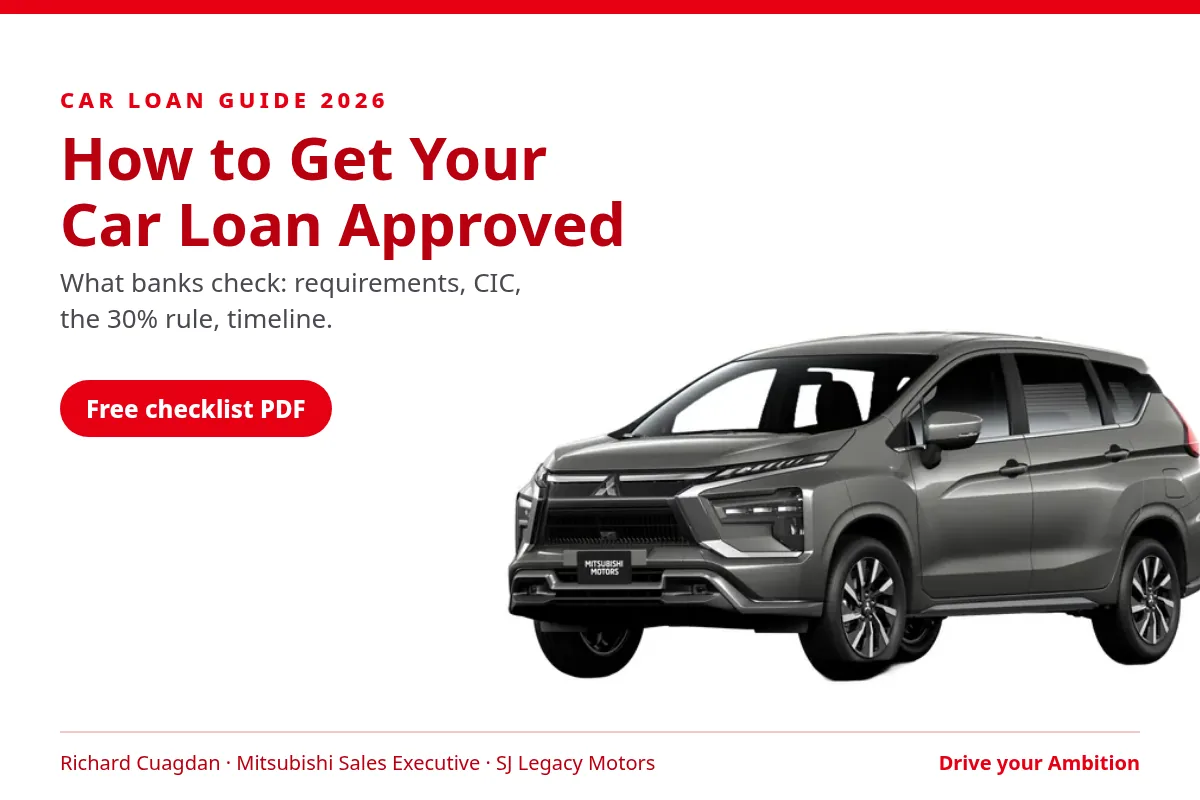
Quick answer: To get your car loan approved, keep your monthly amortization within about 30% of your gross monthly income, keep a clean CIC credit record, and submit complete, consistent documents for your employment type. A bigger down payment, a co-borrower or a more affordable variant all improve your chances. Final approval always rests with the bank.
"Will the bank approve me?" It's the question I hear most at our showroom in San Jose del Monte, from buyers across Bulacan, Caloocan, Fairview and the rest of Metro Manila. The good news: bank approval isn't luck. Banks follow a fairly predictable checklist, and once you know it, you can prepare like a pro.
This guide covers what banks look at, the documents for each employment type, the income rule behind most decisions, and the most common reasons for denial. Want a printable version? Get the free PDF checklist below.
How your down payment affects approval
The bank looks first at your monthly amortization versus your income. A bigger down payment means a smaller loan and a lower monthly, which makes that ratio easier to meet. A smaller down payment means a bigger loan, so your income has to carry a higher monthly. Down payment options depend on the bank and the current dealer offer, so ask before you decide. (For quick tips, see my 10 car loan approval tips; for the application steps, see how to apply for a car loan.)
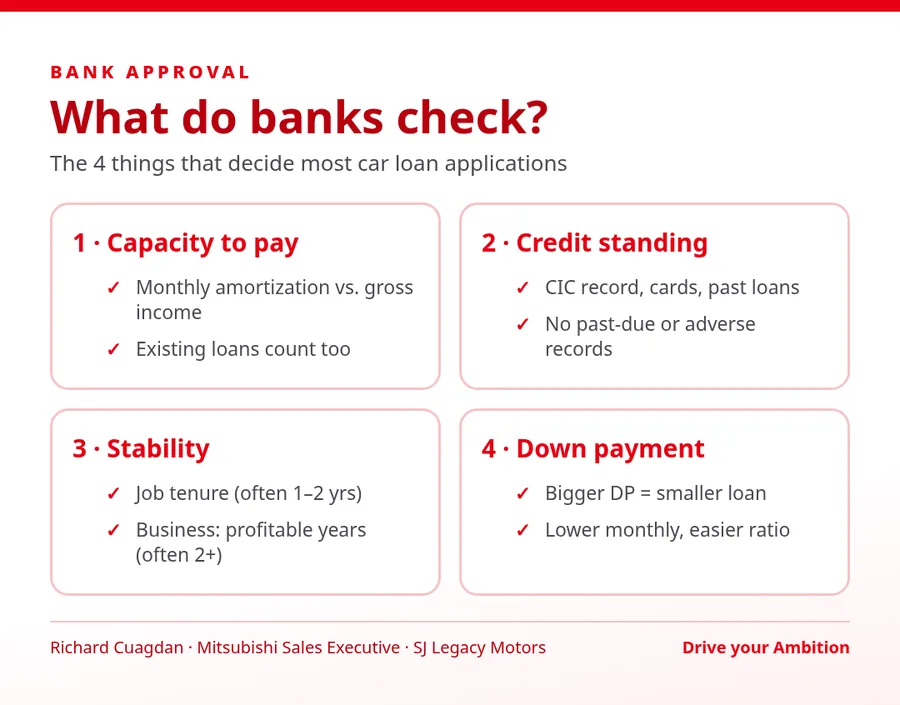
What banks check before approving a car loan
- Capacity to pay: your gross monthly income vs. the monthly amortization.
- Credit standing: your history with loans and credit cards, including your CIC record.
- Stability: how long you've been employed or how long your business has been profitable.
- Completeness and consistency: documents that match each other and can be verified.
- Age and residency: banks set minimum and maximum ages and may ask how long you've lived at your address.
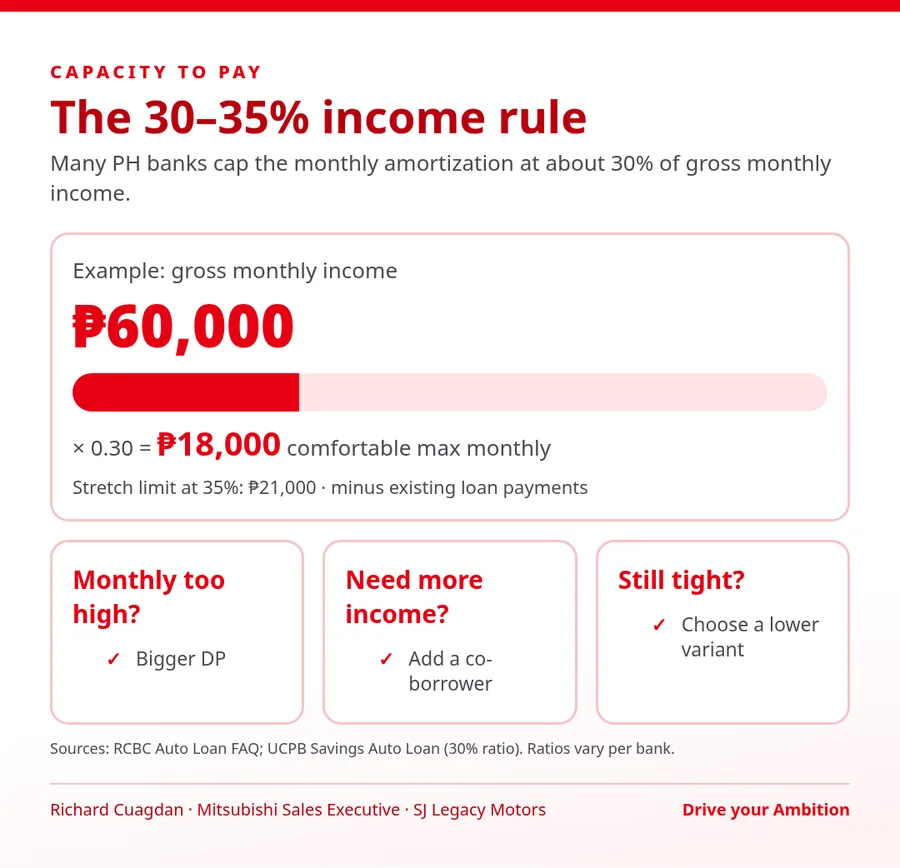
The 30–35% income rule (DTI)
Many Philippine banks cap the monthly car amortization at about 30% of gross monthly income. RCBC and UCPB Savings, for example, publish a 30% ratio. Some lenders may stretch a little, so plan for 30% to 35% at most, and remember that your other existing loans count against that limit.
Quick formula: Gross monthly income × 0.30 = comfortable maximum monthly amortization.
Example: ₱60,000 × 0.30 = ₱18,000. If the monthly for the unit you want is higher, increase the down payment, add a co-borrower's income, or consider a more affordable variant.
Not sure where you stand? See how much car you can afford on your salary.
Credit standing and your CIC report
Banks check for adverse credit records such as past-due credit cards, unpaid loans or bounced checks. The Credit Information Corporation (CIC) collects this data under RA 9510, and you can request your own CIC credit report through CIC's accredited partners before you apply. If anything is wrong or outdated, you can file a dispute with CIC.
- Pay your credit cards on time for several months before applying.
- Settle or restructure past-due accounts and keep the proof.
- Avoid applying for several loans at once.
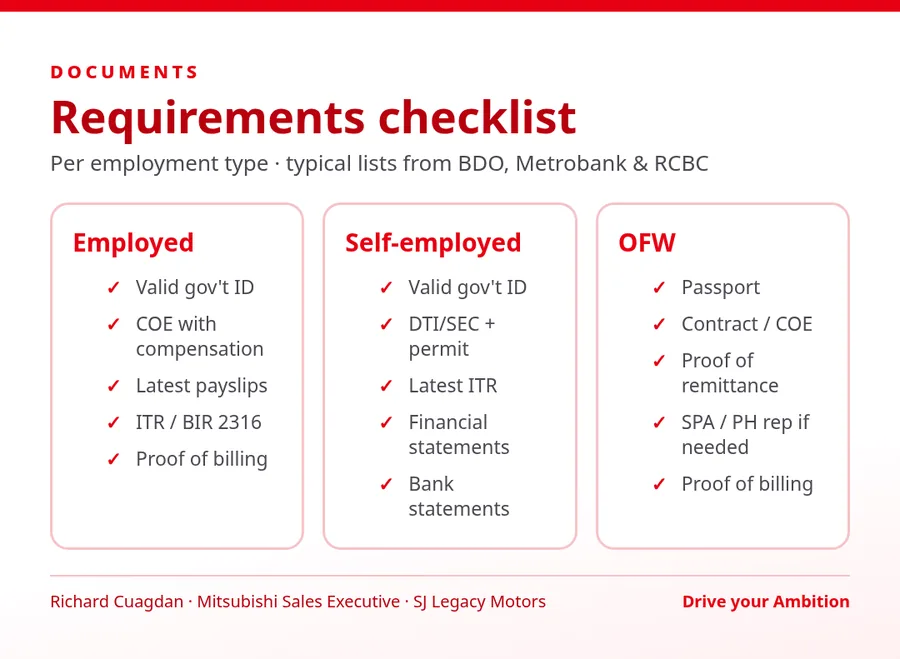
Requirements per employment type
Exact lists differ per bank, but these are what most banks ask for (based on published BDO, Metrobank and RCBC requirements):
Locally employed
- Application form and valid government ID
- Certificate of Employment with compensation (COEC)
- Latest payslips and/or ITR or BIR Form 2316
- Proof of billing
- Often at least 1 to 2 years with your current employer, depending on the bank
Self-employed and business owners
- DTI or SEC registration and business permit
- Latest ITR and financial statements (audited for some banks)
- Recent bank statements (usually several months)
- Usually about 2 years or more of profitable operations
OFWs and seafarers
- Passport and contract or Certificate of Employment with income
- Proof of remittance for recent months
- Special Power of Attorney or a representative/co-borrower in the Philippines, if required
Working abroad? Read my OFW car loan guide for the full process.
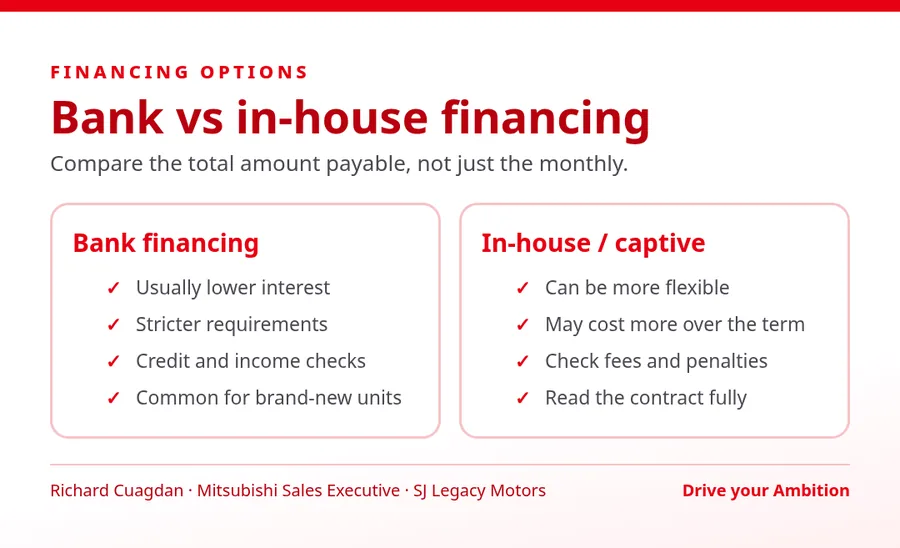
Bank financing vs in-house financing
Bank financing usually has lower interest but stricter screening. In-house or captive financing can be more flexible on requirements but may cost more over the term. I explain the trade-offs in bank vs in-house car financing. My tip: always compare the total amount payable, not just the monthly.
Tips to improve your chances
- Right-size the loan. Choose the variant and down payment that keep your monthly within 30% of income.
- Add a co-borrower, such as a spouse, whose income can be counted (subject to the bank's rules).
- Show all income sources with proof: allowances, business income, rental, remittances.
- Keep documents consistent. Same name spelling, address and employer details on every page.
- Clean up your credit before you apply.
- Apply with the right bank. I can submit to more than one partner bank.
- Stay reachable. Answer the bank's verification call promptly.
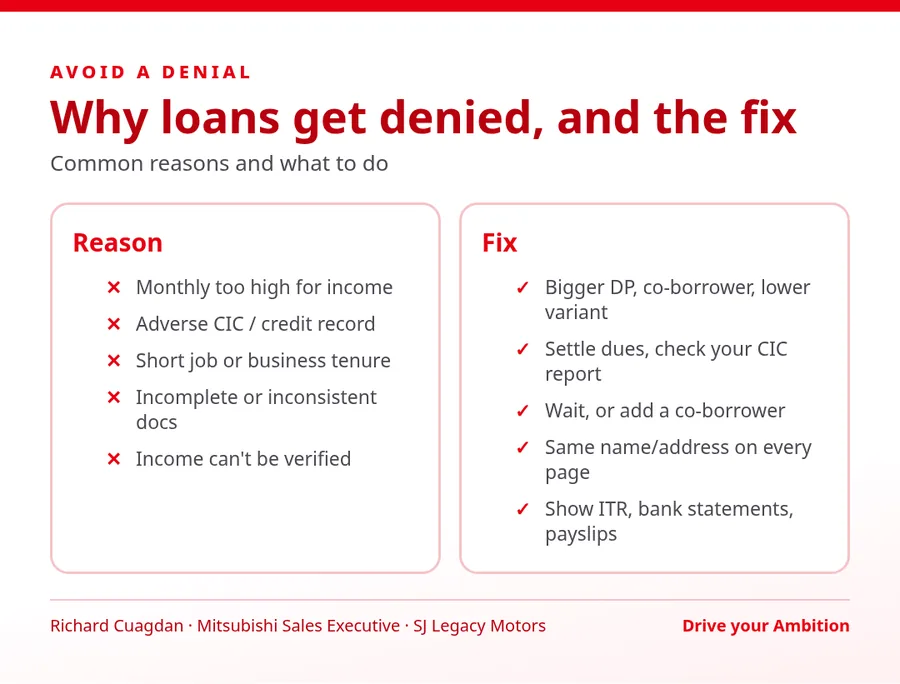
Common reasons car loans get denied
- Monthly amortization too high for the declared income
- Adverse CIC or bank credit records
- Short employment tenure or a new business
- Incomplete, unclear or inconsistent documents
- Income that can't be verified (cash income with no records)
- Missed verification calls or failed address checks
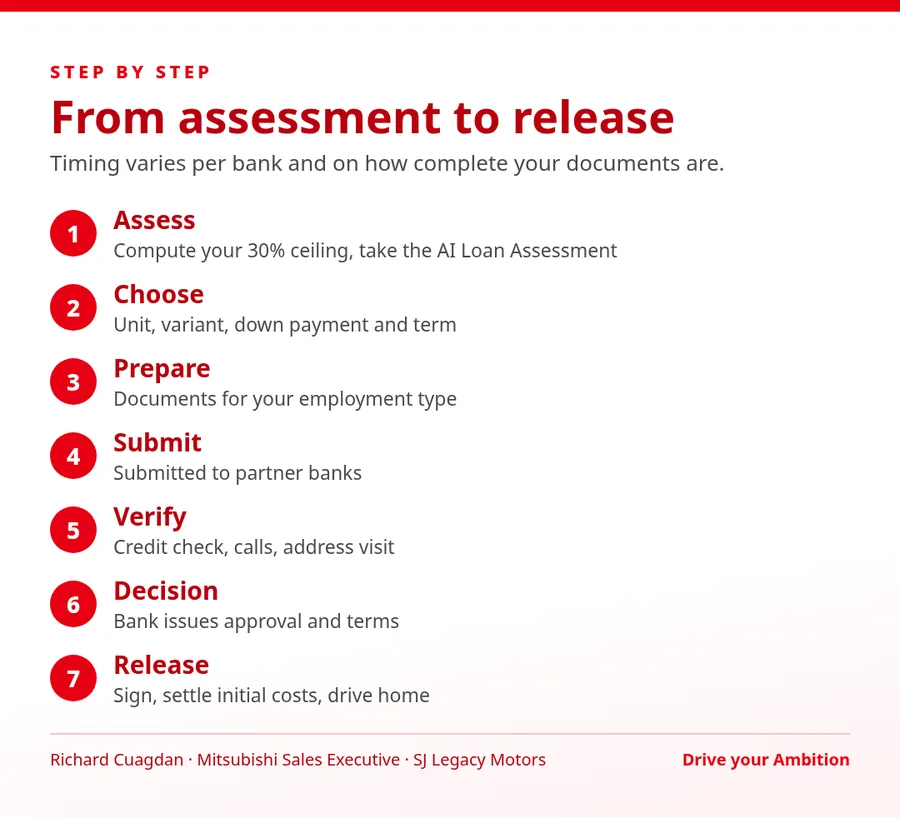
Step-by-step timeline
- Assess: compute your 30% ceiling and take the AI Loan Assessment.
- Choose: pick your unit, variant, down payment and term.
- Prepare: complete the documents for your employment type.
- Submit: I submit your application to partner banks.
- Verify: the bank checks your credit, calls you and your employer, and may visit your address.
- Decision: the bank issues its approval and terms. Timing varies per bank and depends on how complete your file is.
- Release: sign, settle any initial costs, and drive home.
Where to start in Metro Manila and Bulacan
I'm Richard Cuagdan, an authorized Mitsubishi sales executive in San Jose del Monte, Bulacan, and I help buyers across Bulacan and Metro Manila, including our Quezon City branch. You can complete the assessment and send documents online first, then visit when you're ready.
Sources
- RCBC Auto Loan FAQ (amortization not exceeding 30% of gross monthly income)
- UCPB Savings Auto Loan (30% credit ratio)
- Metrobank Car Loan application requirements
- BDO Auto Loan requirements
- CIC: About your credit report
Requirements and ratios vary per bank and can change. All results from our tools are Pre-qualified estimates only; financing is always subject to bank approval.
Free PDF
Car Loan Approval Checklist
Free download: documents, DTI worksheet and timeline in one PDF.
Related reading
Frequently asked questions
What do banks check before approving a car loan?
Mainly your capacity to pay (monthly amortization vs. gross income), your credit history including your CIC record, the stability of your job or business, and whether your documents are complete, consistent and verifiable.
Does a bigger down payment help my approval?
Usually, yes. A bigger down payment means a smaller loan and a lower monthly, which makes it easier to stay within the bank's income ratio. Down payment options depend on the bank and the current dealer offer.
How much salary do I need for a car loan?
There's no single number. Work backwards: your monthly amortization should stay within roughly 30% (at most about 35%) of your gross monthly income. Some banks also publish a minimum gross monthly family income, so check with the specific bank.
What documents do I need for a car loan as an employee?
Usually a filled-out application form, valid government ID, Certificate of Employment with compensation, latest payslips and/or ITR or BIR Form 2316, and proof of billing. Exact lists differ per bank.
Can self-employed people or freelancers get a car loan?
Yes. Banks usually look for business registration (DTI/SEC), ITR and financial statements, and several months of bank statements. Many banks look for at least two years of profitable operations.
Can OFWs apply for a car loan while abroad?
Yes. Expect to submit a contract or Certificate of Employment with income, proof of remittance and a passport. Some banks need a Special Power of Attorney or a representative in the Philippines.
Does my CIC credit report affect car loan approval?
Yes. Banks check your credit history, and adverse records such as unpaid loans or past-due credit cards can lead to denial. You can request your own CIC credit report through CIC's accredited partners before applying.
How long does car loan approval take?
It depends on the bank and on how complete your documents are. Complete, consistent documents are the biggest factor you control. I can follow up with the bank for you.
Why do car loans get denied?
Common reasons are a monthly that's too high for the income, adverse credit history, incomplete or inconsistent documents, short employment or business tenure, and information that can't be verified.
If my car loan is denied, can I apply again?
Yes. Fix the reason first: lower the loan amount with a bigger DP, add a co-borrower, complete your documents or clean up your credit record, then apply with another bank or once your situation improves.